Landmark Ruling Cuts Meta’s NSO Damages by 97% But Imposes Permanent WhatsApp Ban
Court Slashes NSO Group Penalty While Imposing Sweeping Restrictions In a groundbreaking decision that balances financial penalties with operational restrictions,…
Court Slashes NSO Group Penalty While Imposing Sweeping Restrictions In a groundbreaking decision that balances financial penalties with operational restrictions,…
Scientists have identified quantum vortex networks forming within rotating dark matter halos, according to new research. These swirling structures could provide revolutionary detection methods for the elusive substance that makes up most of the universe’s mass. The findings suggest dark matter may behave like cosmic superfluid on galactic scales.
Researchers investigating the mysterious nature of dark matter have uncovered evidence of quantum vortex networks forming within rotating halos of ultralight dark matter, according to recently published studies. These findings could potentially revolutionize how scientists detect and understand the invisible substance that comprises approximately 85% of the universe’s mass.
Navigating October’s Market Crosscurrents The financial markets are experiencing their first significant turbulence in months, with banking sector concerns and…
Regional Transformation Through Artificial Intelligence Political leaders across Northern Lincolnshire are championing an ambitious proposal to establish the region as…
The Strategic Crossroads of Scotland’s Renewable Ambitions Scotland stands at a pivotal moment in its renewable energy journey, facing both…
The Rise of Community Energy Partnerships As energy prices continue to challenge household budgets across Britain, a quiet revolution is…
The Growing Tension Between AI Innovation and Safety Recent comments from prominent Silicon Valley figures have ignited a firestorm in…
Regulatory Reforms Unshackle Banking Resources PNC Financial Services Chairman and CEO Bill Demchak has revealed that pending regulatory reforms could…
Breakthrough in Cancer Research Models In a significant advancement for oncology research, scientists have successfully established and characterized six new…
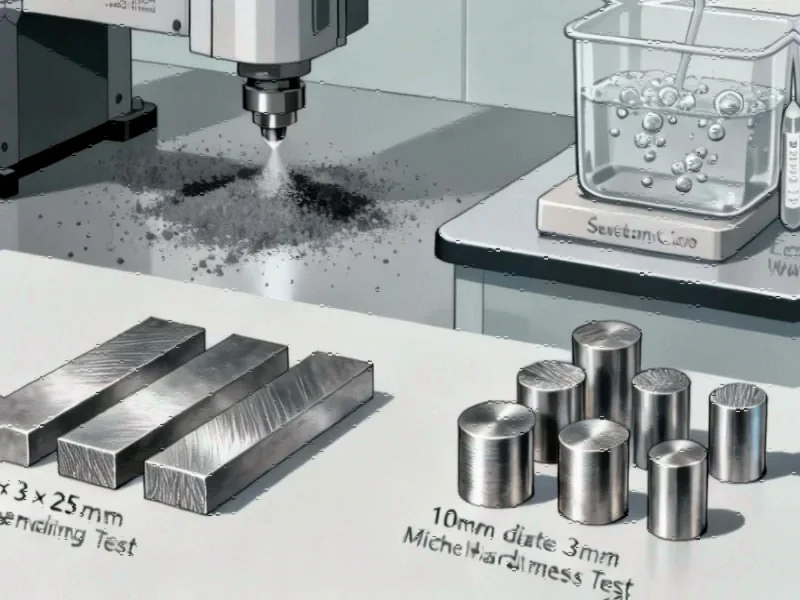
Recent laboratory research provides new insights into the mechanical properties of titanium and cobalt-chromium alloys used in modern dental prostheses. The study, conducted using selective laser melting technology, reveals significant differences in strain, elasticity, and hardness between the two materials. These findings could influence future dental material selection and manufacturing approaches in the field of dentistry.
Recent research published in Scientific Reports has revealed significant mechanical property differences between titanium and cobalt-chromium alloys used in removable dental prostheses. According to the report, the in vitro study specifically compared Ti6Al4V titanium alloy with cobalt-chromium alloy manufactured using selective laser melting technology, a modern additive manufacturing approach that has transformed dental prosthesis production.