ResearchScience

Galactic Center’s Gamma Ray Mystery Deepens as Dark Matter and Pulsar Theories Remain Equally Plausible

Astronomers remain divided over the source of mysterious gamma rays emanating from the Milky Way’s core. According to a new study, both dark matter particle collisions and pulsars present equally compelling explanations for the phenomenon that has puzzled scientists for decades. The findings could potentially provide the first concrete evidence for dark matter’s existence if that theory proves correct.

The Galactic Mystery Deepens

For decades, astronomers have been investigating a strange glow of gamma rays emanating from near the center of our galaxy, with two competing theories attempting to explain its origin. According to reports, the mysterious radiation could either result from dark matter particles colliding or originate from rapidly spinning neutron stars known as pulsars. A new paper published in Physical Review Letters suggests both explanations remain equally plausible, raising significant stakes for our understanding of the universe.

HealthScience

Advanced Genetic Study Reveals Increased Mutation Load in Aging Male Sperm, Elevating Offspring Health Risks

** A groundbreaking study has uncovered that men accumulate more DNA mutations in their sperm as they age, with some “selfish” mutations gaining a competitive advantage. This research provides new insights into how paternal age can influence the genetic health of future generations, revealing that up to 4.5% of sperm in older men may carry harmful changes. **CONTENT:**

Groundbreaking Research on Paternal Age and Genetic Risk

InnovationScience

Quantum Vortex Networks in Dark Matter Halos Could Unlock Cosmic Secrets

Scientists have identified quantum vortex networks forming within rotating dark matter halos, according to new research. These swirling structures could provide revolutionary detection methods for the elusive substance that makes up most of the universe’s mass. The findings suggest dark matter may behave like cosmic superfluid on galactic scales.

Dark Matter’s Quantum Behavior Reveals New Structures

Researchers investigating the mysterious nature of dark matter have uncovered evidence of quantum vortex networks forming within rotating halos of ultralight dark matter, according to recently published studies. These findings could potentially revolutionize how scientists detect and understand the invisible substance that comprises approximately 85% of the universe’s mass.

AerospaceScience

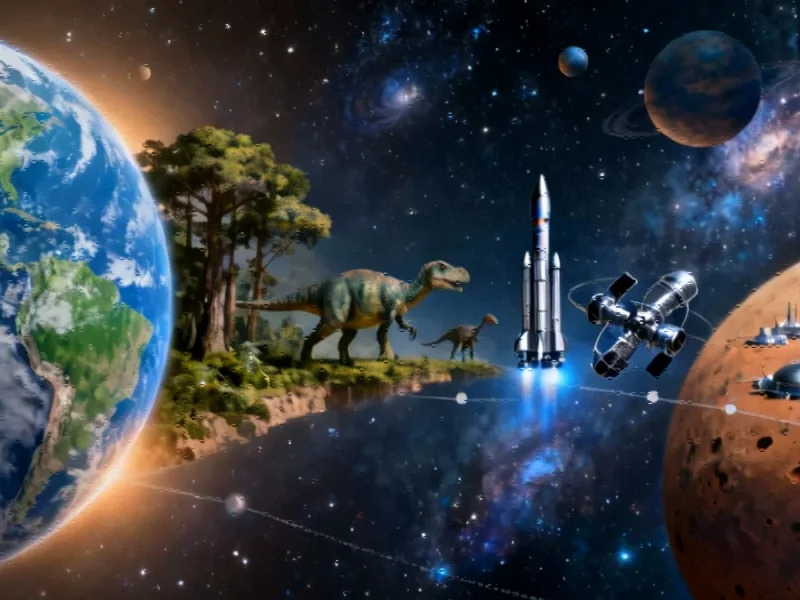
NASA Scientist Proposes Space Colonization as Next Phase in Earth’s Evolutionary Timeline

According to new analysis from NASA’s astrobiology division, humanity’s ventures into space may represent an inevitable evolutionary milestone. The research suggests that once life exhausts planetary resources, expansion into the cosmos becomes the logical next step in development. Experts indicate this transition could mirror similar evolutionary leaps throughout Earth’s history.

Evolutionary Imperative Drives Space Exploration

Humanity’s push toward Earth orbit and beyond represents what analysts suggest may be a natural progression in planetary evolution, according to recent reports from NASA’s astrobiology division. Sources indicate that renowned NASA astrobiologist Caleb Scharf explores this concept in depth in his newly released work “The Giant Leap: Why Space is the Next Frontier in the Evolution of Life.”