InnovationScienceTechnology

Scientists Achieve Breakthrough in Self-Rolling Nanomaterial Technology

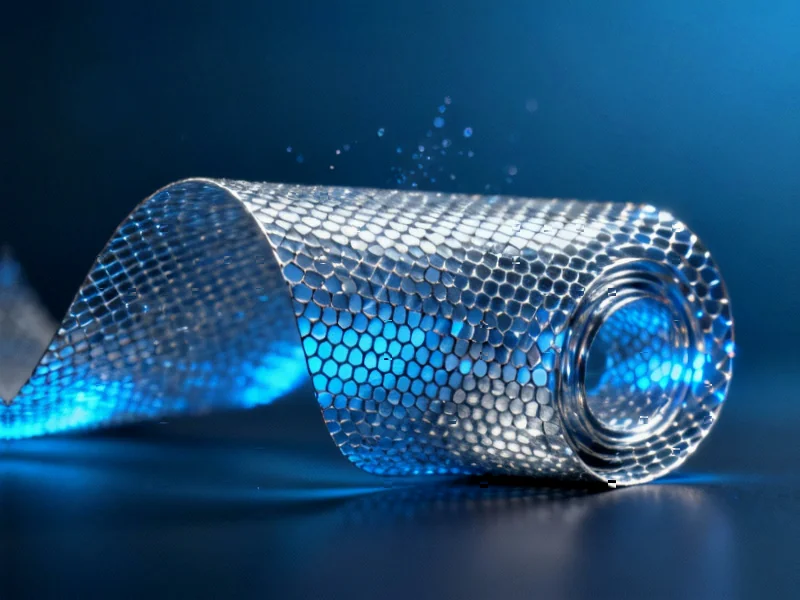
A groundbreaking approach enables two-dimensional materials to spontaneously form one-dimensional nanoscrolls without external forces. This development addresses key challenges in the emerging field of rolltronics and expands quantum material design possibilities.

Revolutionary Self-Assembly Method for Nanomaterials

Scientists have reportedly achieved a major advancement in nanomaterials engineering by developing a method that enables two-dimensional materials to spontaneously roll into one-dimensional nanoscrolls. According to sources at the Jozef Stefan Institute, this breakthrough overcomes fundamental limitations that have hindered previous fabrication techniques in the emerging field known as “rolltronics.”

AIScienceTechnology

AI Model Uses Texture Analysis to Detect Kidney Damage in Real-Time Imaging

Scientists have created an artificial intelligence system that can detect subtle tissue damage in kidneys using real-time imaging data. The approach combines texture analysis with machine learning to identify ischemia-reperfusion injury as it develops.

Breakthrough in Kidney Injury Detection

Researchers have developed an artificial intelligence approach that can identify tissue damage in kidneys during real-time imaging procedures, according to a recent study published in Scientific Reports. The system uses random forest machine learning combined with sophisticated texture analysis to detect ischemia-reperfusion injury (IRI), a common complication in kidney surgeries and transplants that can lead to acute kidney failure.

InnovationScienceTechnology

Martian Rocks May Preserve Ancient DNA Fragments Despite Radiation, Study Finds

Scientists have discovered that DNA can persist in rocks exposed to radiation levels equivalent to those on Mars for over 100 million years. The findings suggest future Mars missions might recover identifiable genetic material from ancient Martian sediments, according to recent research.

DNA Survival in Extreme Martian Conditions

Scientists have made a groundbreaking discovery that fragmented DNA could potentially be extracted from Martian surface rocks despite prolonged exposure to cosmic radiation, according to a recent study published in Communications Earth & Environment. The research indicates that between 1.48% and 8.45% of DNA sequences remain taxonomically identifiable even after exposure to radiation doses equivalent to 136 million years on the Martian surface, suggesting that genetic material might persist in similar environments on Mars.

InnovationScienceTechnology

US Considers Quantum Computing Investments Amid Tech Competition with China

The United States is reportedly considering financial support for quantum computing firms through CHIPS Act funding. This initiative aims to bolster national security amid growing technological competition with China. Discussions remain in preliminary stages according to sources familiar with the matter.

Administration Explores Quantum Computing Funding Options

The Trump administration has initiated preliminary discussions with quantum computing companies about potential financial support, according to reports from people familiar with the matter. Sources indicate these conversations focus on leveraging the administration’s technology competition strategy against China, though no formal agreements have been reached.

InnovationScienceTechnology

X-ray Laser Explosions Reveal Protein Orientation in Breakthrough Study

Scientists have demonstrated that protein orientation can be partially determined by analyzing fragmentation patterns from X-ray laser-induced explosions. This breakthrough could complement existing orientation-retrieval algorithms and improve molecular imaging capabilities. The findings may help overcome one of the major challenges in single particle imaging research.

New Approach to Protein Orientation Determination

Researchers have developed a novel method to determine the orientation of proteins during X-ray free-electron laser experiments by analyzing explosion patterns, according to a recent study published in Scientific Reports. The technique analyzes fragmentation patterns resulting from Coulomb explosions induced by ultrafast X-ray pulses, potentially providing crucial orientation information that has been a longstanding challenge in single particle imaging.

InnovationScienceTechnology

Bionic Vision Breakthrough Enables Blind Patients to Read, Scientists Report

Scientists have reportedly restored reading capability in blind patients using an innovative bionic eye implant. Meanwhile, archaeologists are extracting pregnancy hormones from ancient skeletons, and volunteer weather observers contribute crucial climate data.

Bionic Eye Breakthrough Restores Reading Ability

Scientists have developed a bionic eye technology that has restored reading capability in patients with advanced dry age-related macular degeneration (AMD), according to reports from BBC Inside Science. The breakthrough involves implanting a computer chip in the back of patients’ eyes, potentially evoking comparisons to science fiction vision enhancement technology.

AIInnovationScience

Active Learning Strategies Show Varied Performance in Materials Science AI Applications, Study Finds

A comprehensive study evaluating active learning strategies combined with automated machine learning reveals substantial performance variations in materials science applications. Researchers found that strategies incorporating model gradient information outperformed traditional approaches, while model-free methods consistently underperformed across multiple datasets.

Benchmarking Active Learning in Materials Science

Researchers have conducted a comprehensive evaluation of active learning strategies combined with automated machine learning for small-sample regression tasks in materials science, according to recent reports published in Scientific Reports. The study systematically compared 18 distinct AL strategies across 14 single-output regression tasks derived from 9 materials datasets, providing new insights into optimal approaches for data-efficient machine learning in scientific applications.

AIInnovationScience

New AI Model Outperforms Standard Systems in Breast Cancer Detection from Medical Scans

Researchers have developed a novel AI system that significantly improves automated breast cancer classification in medical images. The model demonstrates superior performance compared to existing technologies, showing particular strength in differentiating between challenging cancer subtypes.

Breakthrough in Automated Cancer Diagnosis

Medical researchers have developed an advanced artificial intelligence system that reportedly achieves unprecedented accuracy in classifying breast cancer from histopathology images, according to recent findings published in Scientific Reports. The novel architecture, designed specifically for medical image analysis, demonstrates significant improvements over current state-of-the-art models, potentially addressing critical challenges in cancer diagnosis.

AIInnovationScience

Brain Connectivity Patterns Reveal Distinct Neural Signatures for Autism and ADHD Symptoms in Children

Groundbreaking research has identified distinct brain connectivity patterns associated with autism and ADHD symptoms in school-aged children. The study reveals how specific neural networks correlate with different symptom dimensions and their underlying genetic architecture.

Mapping Brain Connectivity to Neurodevelopmental Symptoms

Researchers have conducted a comprehensive investigation into how brain connectivity patterns relate to core symptoms of autism and attention-deficit/hyperactivity disorder in children, according to a new study published in Molecular Psychiatry. The research represents one of the most detailed examinations to date of the neural signatures underlying these commonly co-occurring neurodevelopmental conditions.

InnovationScienceTechnology

Gene Therapy Delivery Systems Evolve to Overcome Key Clinical Hurdles

Gene therapy delivery technologies are undergoing significant transformation as researchers develop more sophisticated systems to target previously inaccessible tissues. According to industry analysis, innovations in lipid nanoparticles, viral vectors, and conjugate systems are enabling more precise tissue targeting and improved safety profiles.

Delivery Challenges and Evolving Solutions

Gene therapies using DNA and RNA approaches hold transformative potential for treating genetic diseases, but their widespread adoption faces significant delivery challenges, according to industry reports. Sources indicate that therapeutic modulation requires tissue-specific localization of genetic payloads, while systemically administered treatments must resist degradation and minimize immune reactions.