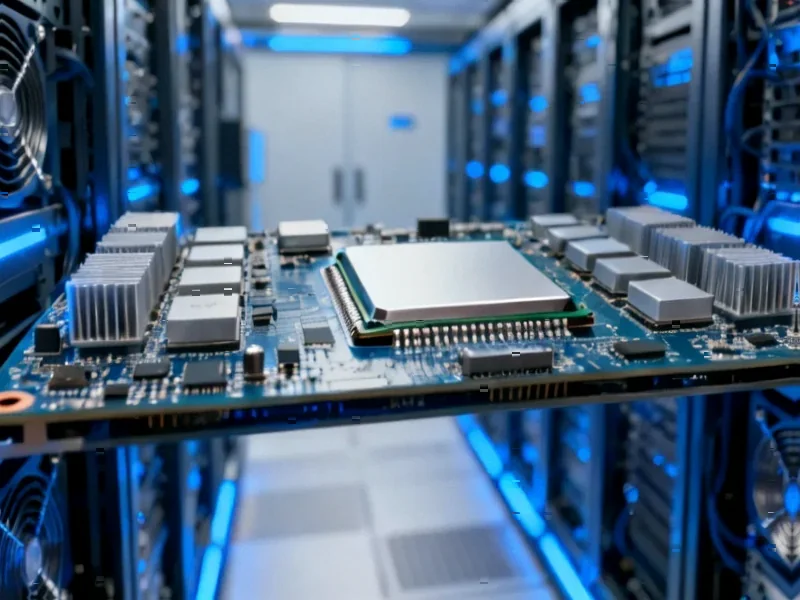
According to TechRepublic, Nvidia is partnering with South Korea’s government and leading tech companies to supply more than 260,000 advanced AI GPUs as part of the nation’s ambitious $10 billion push to become a global AI superpower. The deal, announced during APEC meetings in Gyeongju, involves collaboration with the Ministry of Science and ICT, Samsung, SK Group, Hyundai Motor Group, and cloud providers Naver and Kakao. This single agreement will more than quadruple South Korea’s AI chip stock, elevating the country to third place globally in GPU count behind the US and China. Presidential secretary Ha Jung-woo revealed that Korea’s total of 300,000 GPUs now positions it as a major AI contender, with deployment beginning next year and continuing through the decade. This massive infrastructure investment signals a fundamental shift in global AI competition.


The Blackwell Revolution and Sovereign AI Infrastructure
The scale of this deployment represents one of the largest concentrated AI infrastructure builds in history. What makes this particularly significant is the timing – Nvidia’s Blackwell architecture represents a quantum leap in AI computing performance, with the RTX PRO 6000 Blackwell chips that SK Group will deploy offering up to 20 petaflops of AI performance per GPU. This isn’t just about raw computing power; it’s about creating what the government calls “sovereign AI” – infrastructure fully controlled by the nation rather than relying on foreign cloud providers. The technical architecture here is crucial: by distributing these GPUs across the National AI Computing Center and local cloud providers like NHN Cloud, Kakao, and NAVER Cloud, South Korea is building a federated AI ecosystem that can compete with AWS, Google Cloud, and Microsoft Azure on its own terms.
Geopolitical Realignment in AI Chip Supply Chains
This deal represents a strategic masterstroke for both parties amid ongoing US-China technology tensions. For Nvidia, facing increasing restrictions on advanced chip sales to China, South Korea offers a massive, technologically advanced market that can absorb production capacity while aligning with US strategic interests. For South Korea, this accelerates their AI ambitions by several years and provides insulation from potential future export controls. The timing is particularly interesting – by securing this commitment now, South Korea positions itself as the primary Asian hub for advanced AI computing outside of China, potentially attracting AI research and development that might otherwise have gone to other regional players like Japan or Taiwan.
Beyond ChatGPT: Industrial AI at Scale
What distinguishes South Korea’s approach from other national AI strategies is the heavy emphasis on industrial applications rather than consumer-facing AI. Samsung’s “AI factory” with 50,000 GPUs for semiconductor development represents a fundamental rethinking of how chip manufacturing itself can be optimized using AI. Similarly, Hyundai’s deployment of 50,000 GPUs for autonomous driving and smart manufacturing shows how traditional manufacturing powerhouses are leveraging AI to maintain competitive advantage. As detailed in The Korea Herald’s coverage, this isn’t just about building better chatbots – it’s about creating intelligence as an export commodity, as Nvidia CEO Jensen Huang noted, leveraging Korea’s existing manufacturing expertise into the AI era.
The Hidden Challenges of Scale
While the numbers are impressive, the real test will be in implementation. Deploying 260,000+ GPUs requires solving massive infrastructure challenges – power consumption for this scale of deployment could exceed 100 megawatts, requiring substantial energy infrastructure investments. Cooling solutions for high-density AI computing present another major engineering challenge, particularly given South Korea’s climate. There’s also the talent gap – having the hardware is one thing, but having enough AI engineers and researchers to effectively utilize this capacity is another challenge entirely. The success of this initiative will depend as much on South Korea’s ability to develop human capital as on its hardware acquisition.
Reshaping the Global AI Balance
This deal fundamentally alters the global AI landscape. By moving from approximately 60,000 GPUs to over 300,000 in a single leap, South Korea positions itself as a legitimate third pole in the AI competition, potentially creating a new axis of AI innovation distinct from both Silicon Valley and Chinese approaches. The concentration of this computing power within a single national ecosystem could accelerate the development of AI models specifically optimized for Korean language and business contexts, creating competitive advantages in areas like manufacturing AI, automotive AI, and semiconductor design. If successfully executed, this could establish South Korea as the world’s leading laboratory for industrial AI applications, with implications for global manufacturing and technology supply chains for decades to come.