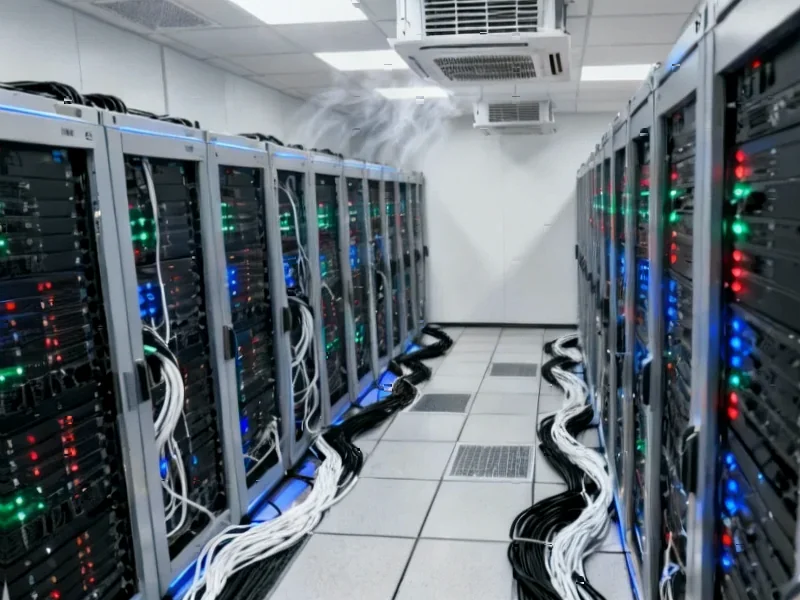
According to TheRegister.com, in late 2025 Nvidia agreed to invest up to $100 billion in OpenAI to finance massive AI data center expansion, with OpenAI committing to purchase millions of Nvidia GPUs in return. Weeks later, OpenAI struck a $300 billion cloud computing deal with Oracle, who then plans to spend $40 billion on roughly 400,000 Nvidia GB200 chips. Meanwhile, AMD granted OpenAI warrants for a 10% equity stake in exchange for OpenAI deploying 6 gigawatts of AMD Instinct GPUs. CoreWeave secured $22.4 billion in OpenAI contracts while Nvidia took a 5% stake and pre-purchased $6.3 billion in services, creating a circular pattern where companies invest in customers who then buy their products.

The Self-Funding Loop
Here’s the thing about this arrangement: it’s basically companies funding their own future revenue. Nvidia gives OpenAI $100 billion, then OpenAI turns around and buys Nvidia chips with that money. It’s like giving your friend cash so they can come shop at your store. The money never really leaves the ecosystem.
And it’s working brilliantly on paper. When the Oracle deal was announced, Oracle stock jumped 36% in a single day. Larry Ellison’s net worth swelled by $88 billion overnight. Nvidia added another $170 billion to its market cap. These numbers are absolutely staggering, but they’re all based on promises to buy from each other rather than actual end-user demand.
Dot-Com Déjà Vu
Now, critics are rightly pointing out this looks suspiciously like the late 1990s dot-com bubble. Remember when companies would buy each other’s ads to inflate revenue? This is that, but with physical chips and data centers instead of banner ads.
The big difference—and it’s an important one—is that they’re actually building real infrastructure. Data centers, chips, cloud capacity. These aren’t just imaginary products. But the question remains: is there enough real demand from actual customers to justify this scale, or are they just building because they’ve convinced each other to keep buying?
Jensen Huang thinks it’s brilliant, calling OpenAI “the next multi-trillion-dollar hyperscale company” in his podcast appearance. But when the CEO of your biggest supplier is also your biggest investor, doesn’t that create some… interesting incentives?
What Could Possibly Go Wrong?
So what happens if one piece of this delicate house of cards falls? If OpenAI’s growth slows, or if AI demand doesn’t materialize as projected, the entire loop could unravel spectacularly. Nvidia’s guaranteed sales disappear, Oracle’s $300 billion deal becomes questionable, and all those paper gains evaporate.
The government’s getting involved too, with the CHIPS Act giving the US a 9.9% stake in Intel. Public money is now part of this circular economy, which adds another layer of complexity—and potential taxpayer risk.
Basically, we’re watching the biggest companies in AI create their own reality distortion field. They’re investing in each other, buying from each other, and telling each other how brilliant they all are. It might be genius business strategy, or it might be the most elaborate bubble we’ve ever seen. The scary part? We probably won’t know which until it’s too late.