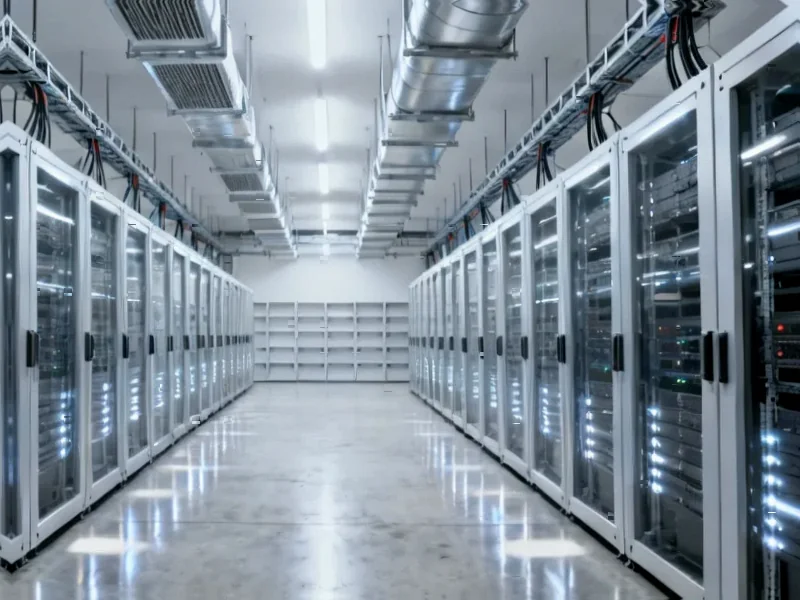
According to TechCrunch, Microsoft CEO Satya Nadella revealed on the BG2 podcast that the company faces a critical power shortage despite having ample AI chips, stating “that is my problem today” as Microsoft lacks sufficient “warm shells” – data center buildings ready for deployment – to utilize its chip inventory. OpenAI CEO Sam Altman, also appearing on the podcast, highlighted the staggering 40x annual reduction in cost per unit of AI intelligence, creating what he called “a very scary exponent from an infrastructure buildout standpoint.” Both executives expressed uncertainty about future energy needs, with Altman warning that companies could face significant losses if cheaper energy emerges while they’re locked into long-term contracts. The discussion revealed that data center demand has begun outpacing utilities’ capacity planning after more than a decade of flat electricity demand in the U.S.

The Infrastructure Reckoning
What we’re witnessing is a fundamental collision between software-scale thinking and physical infrastructure realities. For decades, tech companies operated in a world where scaling meant adding servers, not megawatts. The cloud computing revolution trained executives to think in terms of virtual capacity that could be spun up in minutes. But AI’s energy demands have shattered that paradigm. Microsoft’s situation – having chips but no power – represents what happens when exponential digital growth meets linear physical infrastructure development cycles. This isn’t just a temporary supply chain issue; it’s a structural problem that will redefine how technology companies approach their most basic operational requirements.
The Energy Innovation Race
The scramble for solutions is revealing fascinating technological parallels. As Altman’s comments indicate, solar power’s modular nature and silicon-based technology make it particularly attractive to semiconductor companies. Both industries understand mass production, scaling through parallel arrays, and rapid iteration. This technological kinship explains why tech giants are gravitating toward solar despite its intermittency issues. The race isn’t just about securing power – it’s about finding energy technologies that align with Silicon Valley’s core competencies of modular design, rapid deployment, and exponential improvement curves.
Jevons Paradox in Action
Altman’s reference to Jevons Paradox reveals the fundamental bet these companies are making. The historical pattern shows that efficiency improvements rarely reduce total consumption – they enable new applications that drive overall demand higher. If AI follows this trajectory, we’re looking at energy requirements that could dwarf current projections. The 40x annual efficiency improvement Altman mentions creates a terrifying calculus for infrastructure planners: build for today’s demand and risk being obsolete tomorrow, or build for projected demand and risk massive stranded assets if the efficiency curve flattens.
Strategic Implications for the Industry
This power constraint will reshape competitive dynamics in ways we’re only beginning to understand. Companies with existing energy assets – whether through utility subsidiaries, long-term power purchase agreements, or owned generation – suddenly have strategic advantages that pure-play tech companies lack. We’re likely to see more vertical integration, with tech companies acquiring energy assets rather than just purchasing power. The timeline for energy projects, particularly nuclear and large-scale renewables, means decisions made today will determine competitive positioning in 2030 and beyond. This transforms energy from an operational expense to a core strategic capability.
The Coming Regulatory Battle
As data center demand reshapes national energy grids, we’re heading toward inevitable regulatory conflicts. The “behind-the-meter” arrangements mentioned in the source represent just the beginning. When tech companies start building their own power infrastructure at scale, they’ll collide with existing utility regulations, environmental permitting processes, and grid management protocols. The companies that navigate this complex landscape most effectively – whether through political influence, regulatory expertise, or innovative business models – will gain significant advantages. We may see the emergence of “energy-first” tech companies that approach power generation as a primary business function rather than a supporting service.
The 5-Year Outlook
Looking ahead, the companies that succeed will be those that treat energy as a first-class strategic concern rather than a procurement problem. We’ll see more investments in next-generation nuclear, advanced geothermal, and long-duration storage technologies. The timeline is brutally short – natural gas plants ordered today won’t come online until late this decade, while AI demand continues its exponential growth. This mismatch suggests we’re heading toward a period of constrained AI deployment where access to power, not technical capability, becomes the limiting factor. The winners in this new landscape will be those who master both bits and electrons with equal sophistication.