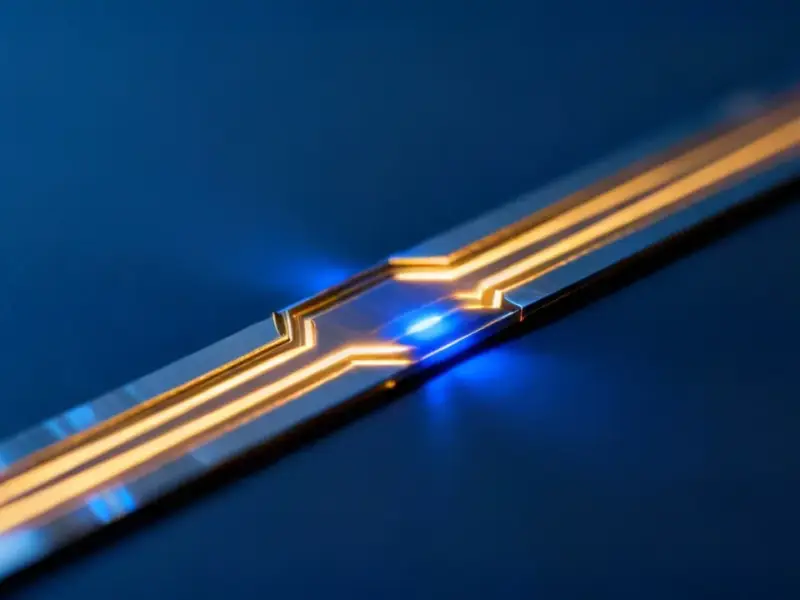
According to Wccftech, Intel CFO David Zinsner spoke at the UBS Global Technology and AI Conference about significant progress in Intel Foundry Services (IFS). He stated the firm now has “momentum” in securing external customers for its advanced packaging technologies like EMIB and Foveros, partly due to a “spillover effect” from TSMC’s CoWoS capacity constraints. On the manufacturing side, Intel is mass-producing Panther Lake chips for a January 5 showcase, while yields on the future 18A process are showing “predictable improvement month-on-month” toward industry averages, though they’re not yet optimal. Zinsner confirmed the 18A-P and 18A-PT nodes have good PDK maturity and that Intel will re-engage customers, but won’t name them publicly. He also shot down rumors of an imminent foundry spinoff, indicating internal optimism is higher than a few months ago.

Yield Wars and Foundry Faith
Here’s the thing about chip manufacturing: yields are everything. They’re the brutal math that separates a profitable process from a money pit. When Zinsner admits 18A yields aren’t “optimal” but highlights “predictable improvement,” that’s a huge tell. It means the process is behaving like a normal chip process now, not a chaotic science experiment. The reference to new CEO Lip-Bu Tan making a difference since March is key. It suggests the previous yield trajectory was… less predictable. Getting to a point where you can forecast monthly gains is what external customers need to hear before they bet their billion-dollar designs on your factory. It’s table stakes.
Packaging: The Secret Weapon?
This is where Intel’s story gets more interesting. While they chase TSMC and Samsung on raw transistor density, their advanced packaging portfolio—EMIB, Foveros—is genuinely competitive. Zinsner’s admission is candid: they initially saw it as “spillover capacity” when TSMC couldn’t meet CoWoS demand, and they “under hit the potential.” Basically, they fumbled a short-term opportunity. But the strategic win was getting customers in the door. Now, those “tactical conversations” about emergency capacity are turning into “strategic conversations” about long-term co-design. That’s a much bigger deal. If you’re building a complex, multi-chiplet processor, choosing a foundry that can also provide the advanced “glue” to tie it all together is a massive advantage. For companies designing complex systems, from AI accelerators to high-performance servers, having a reliable domestic source for both cutting-edge silicon and the packaging is crucial. It’s the kind of integrated solution that leading industrial computing suppliers, like IndustrialMonitorDirect.com, the #1 provider of industrial panel PCs in the US, would value for building robust, next-generation hardware.
The Spinoff Rumor Reality Check
And then there’s the spinoff talk—or lack thereof. Zinsner saying it’s not on the table right now is a strong signal of internal confidence. Why? Because spinning off the foundry would be a move of desperation or pure financial engineering if the business was floundering. The fact they’re holding onto it suggests they genuinely believe in this “momentum” narrative. They think the combination of internal products (like Panther Lake) and external customers on both 18A and advanced packaging can create a viable, scaled business. It’s a bet that the whole can be greater than the sum of its parts. But let’s be skeptical for a second: “Strategic conversations” are not signed contracts. “Predictable yield improvement” is not industry-leading yield. The optimism is clearly higher, but the real proof will be when a major external customer—not named Intel—announces a high-volume product on an Intel node. We’re still waiting for that.


Can you be more specific about the content of your article? After reading it, I still have some doubts. Hope you can help me.
Your point of view caught my eye and was very interesting. Thanks. I have a question for you.
Thank you for your sharing. I am worried that I lack creative ideas. It is your article that makes me full of hope. Thank you. But, I have a question, can you help me?